
If you’ve been shopping for a garage floor coating, you’ve probably seen the word “epoxy” plastered everywhere. It’s been the standard floor coating for decades, and the name has stuck even as the technology has moved on.
Here’s what most people don’t know: Most professional installers have largely moved away from traditional epoxy to polyurea or polyaspartic coatings. So when someone says “epoxy floor,” they may mean an epoxy base with a polyurea top coat, or they may mean a true epoxy system – and the difference matters a lot, especially in Oklahoma.
This post breaks down both products honestly, side by side, so you can make an informed decision.
What Is Epoxy
Epoxy is a two-part resin system – a resin and a hardener – that chemically bonds when mixed and applied to concrete. When it cures, it creates a hard, glossy surface that’s significantly more durable than bare concrete and resistant to many stains and chemicals.
Epoxy has been the go-to garage floor coating for decades because it works. It’s proven, widely available and well-understood by contractors and homeowners alike. The DIY kits at hardware stores are almost always epoxy-based, which is part of why the name is so familiar.
However, epoxy’s limitations show up over time, and they’re worth understanding:
- UV sensitivity – epoxy breaks down in sunlight, causing the surface to yellow, oxidize and fade. A garage with windows, an open door or any outdoor application will show this within a few years.
Long cure time – traditional epoxy takes 3 to 7 days to fully cure, meaning the garage is out of commission for the better part of a week. - Rigidity – epoxy is a hard, inflexible coating. When the concrete underneath expands and contracts with temperature changes – something Oklahoma concrete does constantly – epoxy can crack, chip and delaminate.
- Adhesion over time – without proper surface prep, or when exposed to the right combination of moisture and temperature, epoxy can peel. The DIY kits are especially prone to this because surface preparation is rarely done to a professional standard.
None of this means epoxy is a bad product. It just means it has a specific set of strengths and a specific set of failure modes, and for Oklahoma garages in particular, some of those failure modes are common.
What Is Polyurea
Polyurea is a newer coating chemistry that bonds to concrete at a molecular level rather than sitting on top of it. When applied correctly, it penetrates the concrete surface and creates an adhesion that’s fundamentally different from a surface-level bond like epoxy.
The performance differences are significant and measurable:
- Four times stronger – polyurea has four times the tensile strength of epoxy, which translates directly to resisting impact, abrasion and the kind of daily punishment a working garage delivers.
- UV-resistant – polyurea does not break down in sunlight. It won’t yellow, oxidize or lose its finish regardless of how much sun hits the floor. This matters on any garage with windows, and it’s critical for outdoor applications like pool decks and patios.
- Flexible – polyurea moves with the concrete rather than against it. Oklahoma temperatures swing from sweltering to single digits throughout the year, which causes concrete to expand and contract significantly over time. Polyurea handles that movement without cracking or delaminating.
- Fast-curing – most polyurea applications allow foot traffic in 12 hours and vehicle traffic in 24. One day of installation and the garage is back in service the next morning.
Fully non-porous – the sealed surface resists oil, chemicals, road salt and spills at a level epoxy can’t match. Most stains wipe off instead of soaking in.
Head-to-Head Comparison
Every climate has its floor-coating demands. Oklahoma’s are particularly unforgiving, and they expose epoxy’s weaknesses faster than most.
Temperature extremes
Oklahoma regularly sees below-freezing winters and summers that push past 100°F. Concrete expands and contracts with that range, and it does it repeatedly for years. Rigid epoxy cracks under that kind of sustained movement.
Polyurea’s flexibility is specifically what makes it the right choice here. This isn’t just marketing fluff. It’s the real deal. And it’s the reason Blue Shield uses it exclusively.
Sun exposure
Garages with south-facing doors, windows or any amount of direct sun exposure will see an epoxy floor yellow within a few years. Oklahoma gets roughly 230 sunny days per year, so UV-resistance isn’t optional here – it’s a requirement.
Moisture and storm seasons
Spring storms, humidity and the moisture that tracks in from wet driveways put constant stress on garage floors. Polyurea’s non-porous surface sheds water rather than absorbing it. Less moisture infiltration also means less freeze-thaw damage to the concrete underneath over time.
Why Blue Shield Uses Polyurea
Blue Shield doesn’t offer epoxy. That’s a deliberate choice, not an oversight.
The reason is simple: We want customers who are still bragging about their floor to everyone who walks into the garage five years after we installed it. Polyurea’s durability and one-day cure time means quicker projects, happier customers, fewer callbacks and floors that hold up the way they’re supposed to. We don’t cut corners on products to save a few dollars per job.
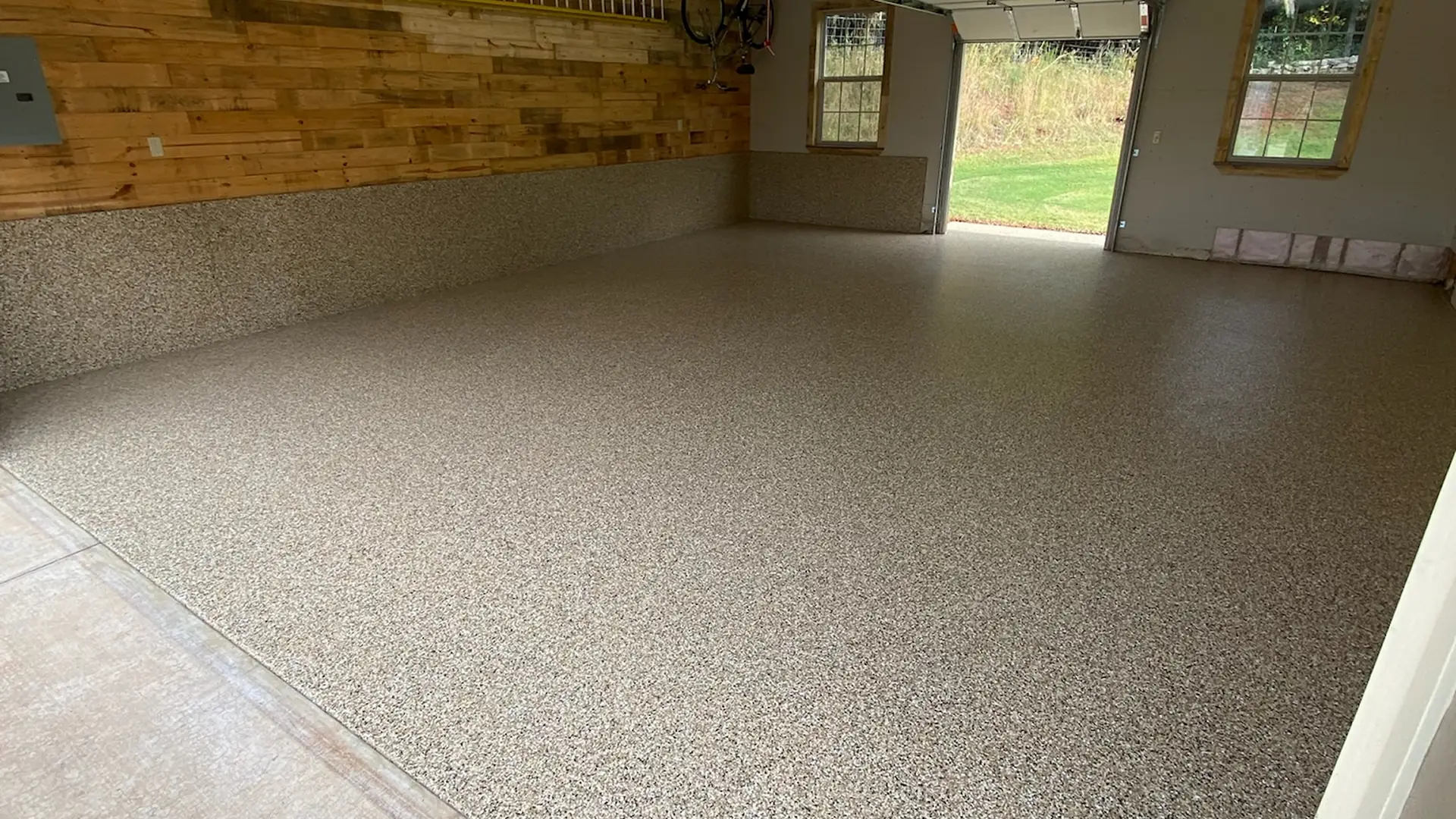
Every Blue Shield residential installation uses 100% polyurea – no epoxy base coats, no hybrid systems that use cheaper materials where you can’t see them. The flake floor you’re getting is polyurea from the base coat to the clear top coat.
Key Takeaways
- Polyurea is four times stronger than epoxy in tensile strength
- Polyurea cures in 12–24 hours; epoxy takes 3–7 days
- Polyurea is UV-resistant and won’t yellow in sunlight – epoxy will
- Polyurea flexes with concrete movement while epoxy cracks under it
- Epoxy costs less upfront but typically needs replacement sooner
- For Oklahoma homes and businesses, polyurea is the better long-term investment
Epoxy is a proven product that works in the right conditions. But if you’re asking what holds up best in an Oklahoma garage – through temperature extremes, sun exposure and daily use – polyurea wins in every category that matters.
Ready to Transform Your Floor?
Blue Shield installs polyurea flake floors for homeowners across the OKC metro – garages, pool decks, patios, driveways and interiors. The estimate is free, the installation takes a day and the result is a floor you won’t stop showing off.
- Free estimate – no obligation, no pressure
- One-day installation on most projects
- 220+ 5-Star Google reviews – more than any floor coating company in the OKC metro
- (405) 535-0266